
Friday, February 17, 2012

Book Covers, Ayn Rand, and some ranting

Living in Paris, I sometimes miss good old English language bookstores. As much as I love the 4-story Gibert Jeune with its 3 euro copies of almost any literary classics, sometimes I yearn for those good old Penguin Classics. That's when I head into one of the few English language shops available: either the wonderful, always crowded, creaky and dusty Shakespeare and Company or its shiny, squeaky clean alternative, the foreign language section of Gibert Jeune. Of course, Paris being more in the vicinity of England than the United States, many of the English language titles tend to carry the British covers rather than the American ones. Which led me to stumble upon the following covers of Ayn Rand's novels:


This is not going to be a "cover comparison" post. It's more of a "cover complaining" post, that is, a response to seeing the above covers for the first time and finding them utterly ridiculous.

Let me start out by saying that I am actually rather fond of Ayn Rand's novels. Her philosophy has problems, yes, and one could argue about it until the cows come home, but I've always found her stories inspiring. Her characters are heroes, who have their own principles and act according to those principles. They are smart and courageous and self-sufficient, and those are things I will always admire. They represent the greatness of man, and that's always inspired me. That's perhaps why I'm so fond of the American covers - they show skyscrapers and trains and sunlight and they do give one the feeling that man can reach the heavens with his creations.

But the above covers...made me laugh. The Atlas Shrugged cover looks rather like John Galt is trying to be...Mr. Darcy? with a bit of Heathcliff? But in America? the Fountainhead one looks like it's trying to be The Great Gatsby (and yes, it's the correct time period). Now, if I were more of an art history expert I'd probably be able to say what artistic movement the covers are pretending to be a part of, but I can't. All I can say is that the covers are pretending to be something, something stylish and literary and artistic and utterly not fitting with the stories themselves. While Rand's stories do have their fair share of snobbishness, elitism and aristocracy, that was not the focus of Rand's stories. It was not the glittery gems and money, it was the personality and intelligence of the characters that earned those rewards that she focused on. Which is why portraying John Galt, a nameless factory worker with the world's greatest mind, as an aristocrat on the cover sort of fails. The woman on the cover of the Fountainhead is presumably Dominique, and she does indeed spend a lot of the book being all tall and skinny and blonde and exquisitely beautiful, just like in that cover illustration, but the Fountainhead is not her story but that of Howard Roark, and of the fountainhead of human creativity: the human mind.

And now I've just spent an inordinate amount of text over-analyzing book covers. At this point, is anyone going to judge Ayn Rand by a cover? She's a bit infamous, at least, in the United States, and those who pick up her books - mostly the young - will do so based on recommendations, the allure of the Ayn Rand Institute's essay prize, or because it made some list of literary classics. But this brings me to my next question: what is the attitude towards Rand in the UK? She's an American author, very concerned with American politics and the American system, and it's easy to see how some people might see her "current." That's not the case in the UK, obviously, and yet she's an English-language author, meaning that there's no barrier of translation. So are these covers the result of a need to market those stories to a UK public? Is their artsy, literary style a way to market these stories as literature, because to a non-American reading public, it's more difficult to market these stories as political and economic and philosophical texts?

Monday, February 6, 2012

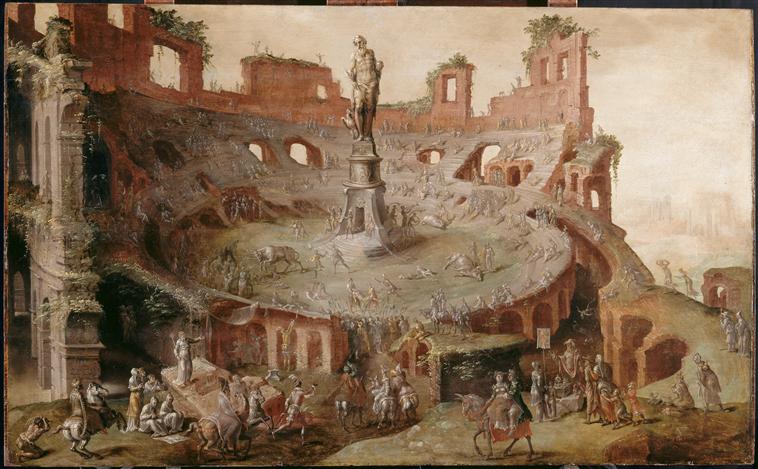
Monday Masterpiece: Heemskerck’s "Course de taureaux à l’antique"

Continuing the trend of focusing on obscure works of art instead of actually masterpieces…(I promise I’ll get to Titian eventually)…this week I’ll be looking at Heemskerck’s Course de taureaux a l'antique, which I stumbled upon in the art museum at Lille, and which I've had a bit of trouble hunting down a picture of since. Click on the image for a larger version of the painting.


Heemskerck was an early Dutch Renaissance artist who helped introduce Italian art to the Netherlands. Like many Renaissance painters, he seems to have been rather fond of Roman ruins, which were rediscovered during the Renaissance. They served as inspiration for the artists and writers who looked back on antiquity and strove to emulate it in their art; Heemskerck in particular is known for his series of paintings of the seven wonders of the ancient world, several of which are classical edifices.

This particular painting falls into a tradition stretching back from the Renaissance through many centuries of painting Roman ruins; it’s a tradition of depicting a great civilization in ruin, paintings of people dwarfed by the broken remains of grandiose columns and dilapidated arches. Yet Heemskerck plays with that format. He creates a tension between past, ruin, destruction and the present, memory, the cycle of life.

The Coliseum-esque arena in his painting is a grandiose ruin that represents the ruin of a grandiose civilization. It towers above the people, but it’s falling apart, cracked and forgotten. The people in the arena are but ghosts, memories of a society long gone. They aren’t really there. Their presence is overshadowed by the medieval looking figures towards the front, who are certainly present and who recall a later age. Some are reminiscent of medieval courtly scenes. They suggest a new age that’s come. The cycle of history will continue as the sands of time obscure what’s past.

And yet…the painting itself is a record, a memory. The ghosts, even if they’re ghosts, are present to us, the viewers. The ruin is still there – it has not been completely effaced from the face of the earth. Greenery, representing life, grows from the very stones, suggesting that even from ruin comes life. The cycle continues, and human life is preserved by memory. Human life will not be effaced. 

Thursday, February 2, 2012

Living in France, part 1

Since I'm in Paris until June and highly opinionated (or overly observant), I thought I'd do some weekly post sharing my thoughts and some interesting highlights. By which I mean, I'm going to complain about how weird/inconvenient living here is. So, here is this week's list:

  1.  Apparently falling in love is a valid excuse for missing a deadline, not doing a particular piece of work, or being late.
  2. Apparently, you cannot view any transactions on your bank account that happened more than 45 days ago. 
  3.  The library of the university I attend has a lower limit on the number of books you’re allowed to borrow, a shorter loan time, and a poorer selection than the Paris public libraries. Deduce what you will about the education system.
  4.  To learn what my grade is, I can't look it up online. I have to go to the campus of the university, find a particular hallway in a particular building, and look for my grade posted on the wall. Sometimes it's there. 
  5.  The book I bought for one of my classes yesterday – a novel- cost the same amount of money as a coffee. Another book I bought – a Moliere play – costs half as much as said coffee. Um. Priorities?
  6. Something is always broken. The elevator, the credit card machine, the metro, the RER, the ATM, the internet…..
  7.  I went out to lunch with a dozen French people today. They said that two bottles of wine would be “too much.” Wait…what?


Friday, January 27, 2012

The Sherlock Holmes Method of Literary Analysis

It was at some point during the twenty-four-hour cycle we call “the day,” and the line between night and morning was becoming just as blurry as the text before my eyes. The play count of several select songs on my iTunes had increased significantly, contributing largely to my feeling of accomplishment, copious amounts of graphite had been left on the pages of a well-worn book in the form of notes and underlining, and I was almost finished with my essay on Wilde’s artistic philosophy as presented in The Picture of Dorian Gray.

It was in that bleary-eyed state that I went for a stroll through the utterly deserted Hyde Park in Chicago. As a part of my brain wondered whether there was another human being left on the planet – hardly likely, it seemed in that complete and utter emptiness – the rest of it considered how well some of Sherlock Holmes’ statements about crime solving applied to literary study.

Of course, that idea is nothing new. That’s what the whole idea of playing “The Game” is about.

If you don’t know what “The Game” is, allow me to explain.

“The game is afoot!” figures among those famous Sherlockian quotes that pop up ubiquitously along with “elementary” and “you see, but you do not observe.” To Sherlock Holmes, that phrase meant that there was a crime to be solved, a challenge to be faced. To us Sherlockians, the notoriously obsessed, it also means that there’s a mystery to unravel. It means pretending that Sherlock Holmes was real and applying his sleuthing skills to fill in the gaps in the Canon. Gaps such as trying to figure out what happened to Holmes’ cocaine habit after The Final Problem, or finding the location of Watson’s strangely mobile war wound.

But what occurred to me during those early morning hours is that those sleuthing skills apply not simply to speculating about how many times Watson was married (between two and six, depending on whom you ask). They apply to writing the kind of literary criticism that the aforementioned essay on The Picture of Dorian Gray involved.

For example:

“I have no data yet. It is a capital mistake to theorize before one has data. Insensibly one begins to twist facts to suit theories, instead of theories to suit facts,” Holmes states in A Scandal in Bohemia.

The above quote embodies the first rule of the study of literature. One does not come up with a thesis and then look for evidence to support that thesis in the book. One lets the book speak. Each quote, symbol, image, color, literary reference, each word, really, is one piece of data. All the pieces of data must be weighed and examined. Then (in my case, at least), lots of logorrhea must ensue, during which thoughts become theories and theories are refined and perfected. And then a thesis emerges. Which makes it sound, of course, like throwing a bunch of pieces of data into a brain-machine, cranking it up, and coming out with a thesis. That’s not inaccurate: Holmes is described by Watson as a reasoning machine, and I like to be able to immodestly say that I emulate his methodical process.
But the ability to reason like a machine is not the only important one. In The Sign of Four, Holmes outlines “three qualities necessary for the ideal detective.” They are: “the power of observation, the [power] of deduction, knowledge.” The literary critic is also a sort of detective, searching for Truth (or a publishable thesis, as the case may be), and those three qualities are invaluable.

Observation: to know what to look for, to notice themes and images and be able to pick out the significant phrases from a text. To notice the imagery of light in a text dealing with knowledge, or in a science fiction novel – such as the fire at the end of Frankenstein. Knowledge – the knowledge of what those themes and images mean, of literary history and context and the influence of both upon the text in general, of what the author knew and how that could have influenced him or her. The knowledge that light is a metaphor for knowledge, for example, or that the word “miracle” comes from the Latin word “to look.” Deduction – the ability to apply knowledge to observations and make deductions. To deduce, for example, that Frankenstein’s death in a fire at the end of the novel symbolizes his destruction through knowledge.

All of that makes it sound, of course, as if books have one clear, unarguable message; that each classic contains one Truth that is as impossible to contradict as the results of Sherlock Holmes’ hemoglobin test. Which just really isn’t true. Literature does have wrong answers, I would argue, but it doesn’t have one right answer. It has right answers. It’s the search for those answers, and what they mean to us, that makes literature meaningful. A wonderful teacher once said to me that when you come up with a thesis that applies to a work of literature, it “clicks.” Really, I think this is true. There will be certain theories about literature that will feel “right.” They will feel like the truth, even if it’s the truth of one’s subjective world, and Sherlock Holmes just might have had something to do with finding that truth. 

Sunday, January 22, 2012

Monday Masterpiece: Procession on Good Friday by Darío de Regoyos y Valdés

The first post (finally!) of what I hope will be a long tradition of presenting artworks and some of my amateur art-lover thoughts on them.


If you’re slightly put off by the above image and find it unexciting….keep reading (though if it sparks your interest, keep reading also).

That was also my first response to this work when I saw it at the Musee de l’Orangerie’s exhibit on Spain titled L’Espagne Entre Deux Siecles.On second glance, I was convinced that this was a very clever piece of artwork. In fact, it’s a brilliant illustration of the way in which a painter can use a composition to turn objects and people into ideas. 

This painting symbolizes three ages in history. Below, the procession of the monks, that is the Middle Ages, a time of faith.  Above it is a Roman bridge – the distinctive rounded arch is a feature of Roman and Romanesque architecture. It symbolizes both ancient Rome and the Renaissance – both times of thought and scientific advancement. And above that, the locomotive symbolizes the modern age, the Industrial Revolution. It’s no coincidence that the train is speeding along on the bridge: after all, the advancements of the Industrial Revolution could not have happened without the Renaissance, without the re-awakening of knowledge. And so the technological progress of the nineteenth century is here, quite literally, supported by earlier ideas, an earlier scientific age.

This sort of vertical composition also implies a hierarchy. Though the painting is titled The procession of Good Friday, the procession – and belief, which it represents – are found in the bottom part of the painting. Both the bridge and the locomotive tower above it, literally. The train blows its steam into an iridescently blue sky, an ethereal blue that contrasts with the dry, dead yellow color of the ground. That steam resembles clouds, as if man had made his way to the sky and reached the clouds. And indeed, a few decades later, man would learn to fly and airplanes would overtake trains.

This is a particularly interesting idea in the context it was in: the exhibit I found the painting in was focused on Spain “between two centuries,” the nineteenth and the twentieth. It was a time of turmoil as the nation simultaneously clung to the past and looked to the future. Here, we see a response to that turmoil, and a hint of the future. 

Sherlock Holmes and "Normality"

I would wager that the average person, if asked to describe Sherlock Holmes, would quite probably mention a detective in an armchair, smoking his pipe, putting his fingers together, and saying “elementary, my dear Watson.” The famous deerstalker cap might come up, too, as well as Holmes courteously questioning his clients and coming to a conclusion without leaving the house.

If you asked that same person whether Sherlock Holmes is “normal,” (s)he would probably say yes. A bit eccentric, perhaps, incredibly smart, but a “normal” British gentleman.

“You have really done very well indeed. It is true that you have missed everything of importance, but you have hit upon the method…”

That, if the reader allows us a quote from A Case of Identity, is quite probably what Sherlock Holmes would say.

Of course, “normality” is one of those words that require quotation marks every time I use them. It’s quite possible that I have a profound fear of making an outrageous or unsupportable claim about something so relative as what is “normal.”  But, whatever the reasons, the point remains that “normality” is subjective. Standards change across time and distance.

With that said, I’d like to point out how, well, not “normal” Sherlock Holmes is.

It’s no secret (to Sherlockians, at least) that Holmes never actually says “elementary, my dear Watson,” in the stories. That comes from a film. He also never actually wears the famous deerstalker cap, which is the invention of illustrator Sidney Paget. And as for the pipe, well, Holmes seems to alternate between that and his cocaine addiction.

In fact, when we first meet Sherlock Holmes in in A Study in Scarlet, he comes off as arrogant and eccentric, has an obsession with crime, the IQ of a criminal mastermind, and a complete ignorance of the fact that the earth goes around the sun.  Instead of being the rather altruistic detective who sacrifices himself to free the world of the greatest criminal mastermind, he complains about the lack of criminality:

“There are no crimes and no criminals in these days,’ he said querulously. “What is the use of having brains in our profession?”

Yet the image of Sherlock Holmes that remains in our minds is the one I began this article with. That image is accurate if one reads nothing but The Adventures of Sherlock Holmes and The Memoirs of Sherlock Holmes. In those stories, Holmes is an entirely different man from the one we first meet. He does, indeed, appear to be a normal British gentleman, quotes Goethe, and often laments his inability to prevent a crime.

So, what happened? Why is Holmes so different in the first two novels than in the stories, and why is the latter image of him more prevalent?

I think it would be safe to claim that the most popular Sherlock Holmes books are The Adventures and The Memoirs of Sherlock Holmes; even in Doyle’s time, they were far more famous than the two novels that introduced him, A Study in Scarlet and The Sign of Four. Thus, it seems safe to assume that, given two rather antithetical images of Holmes, the more prevalent one comes from the more famous stories.

But then the question remains: why this discrepancy? That is, if one does not write it off as an error on Doyle’s part, what happened? Did Holmes change and, if so, why?

One possible reading is the influence Watson had on Holmes.  Watson, dear Watson, sometimes comical, always at a loss as to where Sherlock gets his conclusions from, but a loyal friend and chronicler…Holmes finds him indispensable and cannot work without his Boswell. May we deduce from this close relationship between the two that Watson has actually changed Sherlock?  That their “intimate relationship” changed Holmes from a slightly sociopathic loner to a more sociable, though still “Bohemian,” soul?

In any case, one may do well to remember that the original Holmes that readers were introduced to was not the calm, educated gentleman. He’s a man who probably hasn’t heard of Shakespeare. Which raises the question: does the impression we have of the detective come, perhaps, from seeing what we want to see?

Saturday, January 14, 2012

Review: The Scar Crow Men - Mark Chadbourn

It’s been said once, it’s been said a million times: sequels are hard.

Mostly, that’s because the author has to compete with his own originality. A first novel of a series often introduces a stunning magical world that will whisk the readers away by its very originality. In a sequel, however, the novelty of a faraway land fades away; the unexpected becomes familiar. Hence, the characters, plot, storytelling and humor in a sequel need to be pretty damn amazing to make up for what’s lost in novelty. The author can’t just do the same thing – he has to do something twice as good.

That, unsurprisingly, is the problem with Mark Chadbourn’s The Scar-Crow Men. It’s a sequel. 


It's set in the same intricate, but now familiar world, a magical Elizabethan England, and continues the story begun in The Silver Skull of Will Swyfte and Walsingham's band of spies (though Walsingham is dead by this point) in their fight against the Unseelie Court. Chadbourn's originality in the ways he intertwines history and myth is still stunning: the Plague becomes the doing of the Unseelie Court, Marlowe's Faustus actually conjures up a devil...but the characters and plot are less engaging this time around, and that, coupled with a familiar world, is a death sentence for a story.


In my previous review of The Silver Skull, I explained the kind of characters that we women like to develop infatuations with (and who are heroic enough for men to probably like reading about them too). We like our bitter, cynical, disenchanted yet heroic men...we really, really don't like it when those men whine about it. Perhaps two hundred years ago, back when Romanticism was all the vogue, and writers from Byron to Chateaubriand were inventing being emo, that would've been cool. Nowadays, an occasional bitter line is quite attractive, proffered tantalizingly here or there. Mark Chadbourn, however, has treated the readers to very large helpings of such lines. This is true not only of Will Swyfte, but of all the protagonists of this novel. They complain disenchantedly about their happy past, about what they've lost, about how they can't be happy, about their sacrifices. Oh, shut up already, and actually do something interesting. 


It's not even that the characters are unlikeable, or pretend to be heroes when they're not, or that I"m a terrible, heartless person who doesn't care (I am a terrible, heartless person, but fictional characters have been known to melt the ice that I have in place of a heart). It's that they'd be much more interesting as characters if they actually did things instead of complaining about things. After all, with the first book, the reader signed up for reading a book about Bitter, Cynical Heroes doing Heroic Things (and not for reading The Sorrows of Young Werther). In this book, the bitter and cynical is there, but the heroic seems to have gone for a walk somewhere.

That's why I'm rather hard-pressed to summarize the plot of the novel. It begins with London being stricken by the Plague, and Marlowe getting murdered. After that, there's a lot of angry Will Swyfte running away from things and blundering about, only to then conveniently be informed of the enemy's plot by an ally a few chapters from the end. An appearance is made by Red Meg, a feisty, red-haired Irish spy, who strides her way confidently through the story and rescues Will on more than one occasion. She brightens the story with her flaming red hair and fiery personality, but it's certainly not enough to make the tale colorful and engaging.

It may be universally agreed that sequels are hard, but it's also universally agreed that the third time's the charm. The question remains: will the next book be just the sequel of a sequel, and hence even less up to par, or will Chadbourn work his magic again?