Showing posts with label monday masterpiece. Show all posts

Monday, February 6, 2012

Monday Masterpiece: Heemskerck’s "Course de taureaux à l’antique"

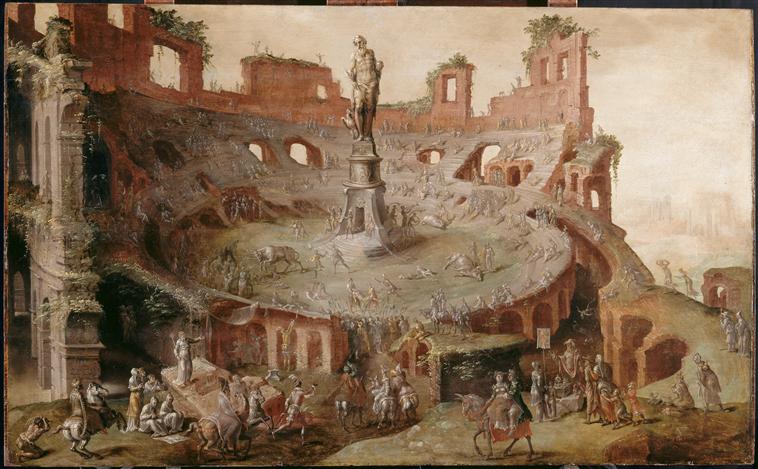
Continuing the trend of focusing on obscure works of art instead of actually masterpieces…(I promise I’ll get to Titian eventually)…this week I’ll be looking at Heemskerck’s Course de taureaux a l'antique, which I stumbled upon in the art museum at Lille, and which I've had a bit of trouble hunting down a picture of since. Click on the image for a larger version of the painting.


Heemskerck was an early Dutch Renaissance artist who helped introduce Italian art to the Netherlands. Like many Renaissance painters, he seems to have been rather fond of Roman ruins, which were rediscovered during the Renaissance. They served as inspiration for the artists and writers who looked back on antiquity and strove to emulate it in their art; Heemskerck in particular is known for his series of paintings of the seven wonders of the ancient world, several of which are classical edifices.

This particular painting falls into a tradition stretching back from the Renaissance through many centuries of painting Roman ruins; it’s a tradition of depicting a great civilization in ruin, paintings of people dwarfed by the broken remains of grandiose columns and dilapidated arches. Yet Heemskerck plays with that format. He creates a tension between past, ruin, destruction and the present, memory, the cycle of life.

The Coliseum-esque arena in his painting is a grandiose ruin that represents the ruin of a grandiose civilization. It towers above the people, but it’s falling apart, cracked and forgotten. The people in the arena are but ghosts, memories of a society long gone. They aren’t really there. Their presence is overshadowed by the medieval looking figures towards the front, who are certainly present and who recall a later age. Some are reminiscent of medieval courtly scenes. They suggest a new age that’s come. The cycle of history will continue as the sands of time obscure what’s past.

And yet…the painting itself is a record, a memory. The ghosts, even if they’re ghosts, are present to us, the viewers. The ruin is still there – it has not been completely effaced from the face of the earth. Greenery, representing life, grows from the very stones, suggesting that even from ruin comes life. The cycle continues, and human life is preserved by memory. Human life will not be effaced. 

Sunday, January 22, 2012

Monday Masterpiece: Procession on Good Friday by Darío de Regoyos y Valdés

The first post (finally!) of what I hope will be a long tradition of presenting artworks and some of my amateur art-lover thoughts on them.


If you’re slightly put off by the above image and find it unexciting….keep reading (though if it sparks your interest, keep reading also).

That was also my first response to this work when I saw it at the Musee de l’Orangerie’s exhibit on Spain titled L’Espagne Entre Deux Siecles.On second glance, I was convinced that this was a very clever piece of artwork. In fact, it’s a brilliant illustration of the way in which a painter can use a composition to turn objects and people into ideas. 

This painting symbolizes three ages in history. Below, the procession of the monks, that is the Middle Ages, a time of faith.  Above it is a Roman bridge – the distinctive rounded arch is a feature of Roman and Romanesque architecture. It symbolizes both ancient Rome and the Renaissance – both times of thought and scientific advancement. And above that, the locomotive symbolizes the modern age, the Industrial Revolution. It’s no coincidence that the train is speeding along on the bridge: after all, the advancements of the Industrial Revolution could not have happened without the Renaissance, without the re-awakening of knowledge. And so the technological progress of the nineteenth century is here, quite literally, supported by earlier ideas, an earlier scientific age.

This sort of vertical composition also implies a hierarchy. Though the painting is titled The procession of Good Friday, the procession – and belief, which it represents – are found in the bottom part of the painting. Both the bridge and the locomotive tower above it, literally. The train blows its steam into an iridescently blue sky, an ethereal blue that contrasts with the dry, dead yellow color of the ground. That steam resembles clouds, as if man had made his way to the sky and reached the clouds. And indeed, a few decades later, man would learn to fly and airplanes would overtake trains.

This is a particularly interesting idea in the context it was in: the exhibit I found the painting in was focused on Spain “between two centuries,” the nineteenth and the twentieth. It was a time of turmoil as the nation simultaneously clung to the past and looked to the future. Here, we see a response to that turmoil, and a hint of the future.